


- ›
- Stories
- ›
- Uncategorized
- ›
- Assisted Cycling Therapy for Parkinson’s: How Theracycle Supports Movement and…
Stories
Assisted Cycling Therapy for Parkinson’s: How Theracycle Supports Movement and Brain Health

Assisted Cycling Therapy for Parkinson’s: How Theracycle Supports Movement and Brain Health
Living with Parkinson’s disease often means navigating stiffness, tremors, slowed movement, and fatigue. While medications play an important role, research increasingly shows that exercise is one of the most powerful complementary therapies available. Among the most studied approaches is assisted cycling therapy, also known as forced or motor-assisted cycling.
What Is Assisted Cycling Therapy?
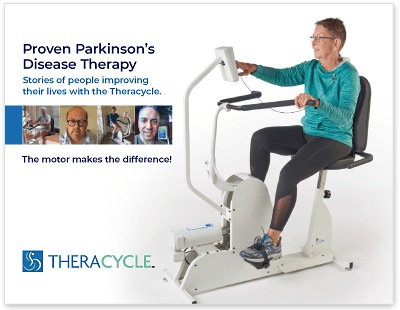
Assisted cycling therapy uses a motorized bike that helps the rider maintain a higher and more consistent pedaling speed than they could achieve alone. Unlike traditional stationary cycling—where the rider controls the pace—assisted cycling gently supports movement, encouraging a steady cadence even when muscles feel stiff or fatigued.
Why does this matter?
Studies suggest that maintaining a higher cadence may stimulate the nervous system in ways that:
Improve motor coordination
Reduce rigidity
Support balance and gait
Promote neuroplasticity (the brain’s ability to adapt)
For individuals with Parkinson’s, consistent rhythmic movement can help retrain neural pathways involved in motor control.
The Science Behind It
Parkinson’s affects dopamine-producing neurons, which are essential for smooth and coordinated movement. High-cadence cycling may activate motor circuits in the brain and help improve communication between neurons.
Many clinicians observe improvements in:
Walking speed
Stride length
Reduced freezing episodes
Overall confidence in mobility
While assisted cycling is not a cure, it can be a powerful tool in a comprehensive Parkinson’s care plan.
How Theracycle Supports Assisted Cycling
Theracycle is designed specifically to make assisted cycling accessible, safe, and effective at home or in clinical settings.
Key benefits include:
Motor-assisted movement – Maintains consistent cadence even when fatigue sets in
Low-impact design – Gentle on joints and suitable for daily use
Stable and safe structure – Designed for individuals with balance challenges
Customizable speed settings – Adaptable to different stages of Parkinson’s
By removing the physical barrier of starting and maintaining pedaling speed, Theracycle allows users to focus on movement quality rather than effort alone.
Empowering Independence Through Movement
Perhaps the most meaningful impact of assisted cycling therapy is psychological. Regular exercise improves not only motor function but also mood, energy levels, and self-confidence. Being able to exercise safely at home empowers individuals to take an active role in managing their condition.
Assisted cycling is more than exercise—it is movement with purpose.
For individuals seeking structured, motor-supported therapy, devices like Theracycle offer a practical and research-informed way to stay active and engaged in their rehabilitation journey.